


THE BEST FINANCIAL LITERACY COURSES FOR KIDS AND TEENS

Updated: 5 days ago

What You'll Learn:
Let’s talk about something that’s often overlooked but is absolutely critical for our kids' futures: financial literacy. You might be thinking, “What’s the big deal?” or “Aren’t they too young to worry about money?” Trust us, understanding finances is one of the most valuable gifts we can give our children - and it's never too early.
What is Financial Literacy?
We know this term gets thrown around a lot, but financial literacy is all about understanding money and knowing how to make it work for you. But it’s not just about understanding what money is or how to spend it—it’s about grasping concepts like budgeting, saving, investing, credit, and the balance between spending and earning. A financially literate kid will eventually become an adult who can confidently manage their finances, avoid debt traps, and build wealth.
Imagine if we had been taught these skills in school. Now, imagine giving our kids the advantage of this know-how early on. KidVestors teaches these essentials and helps them build strong financial habits from the start.
Why is Financial Literacy Important?
Financial literacy is the life skill that you need and can't live without. Here’s why:
Money Affects Everything: Whether it’s choosing a career, saving for a home, or planning for retirement, money is at the core of many important life decisions. Teaching our kids how to handle money sets them up for success in the “real world.”
Avoiding Financial Pitfalls: We’ve all seen how easy it is to fall into debt, make impulsive spending decisions, or sign up for a credit card with less-than-friendly terms. Financial literacy gives kids the tools to navigate these potential pitfalls with confidence.
Building Financial Independence: Understanding money is the key to financial independence. With the right tools, our kids won’t just be financially savvy; they’ll be financially free.
A Holistic Approach
We can’t talk about financial literacy without talking about a holistic approach. Let’s imagine financial literacy as a table with four legs: earning, saving, spending, and investing. If you only focus on one of those legs, the table won’t stand for long, right? Kids need a balanced understanding of all aspects of money management to be truly empowered.
Breaking Down the Four Pillars of Financial Literacy
Earning: Kids should know where money comes from, how it’s earned, and what different income sources mean (like jobs, side hustles, or investments).
Saving: They’ll learn how to set money aside for future goals, emergencies, or big dreams. Saving teaches patience, planning, and the value of foresight.
Spending: Not all spending is bad; learning to spend wisely is a critical part of financial health. This means knowing when it’s okay to splurge and when it’s better to save.
Investing: Growing wealth isn’t just about working hard; it’s about making money work for them. Investing introduces kids to concepts like stocks, real estate, and even business ownership.
When kids only learn about one or two financial skills in isolation—like budgeting or credit—they miss out on how these skills connect to a bigger picture. It’s like learning to drive a car but only understanding the gas pedal and not the brakes. For instance, if your child learns about saving but never learns about investing, they could end up stashing their money without knowing how to make it grow - and falling behind as a result of inflation.
Similarly, learning about credit without understanding how to earn and budget could lead to borrowing without a plan to pay it back. By approaching money holistically, kids learn how these concepts work together, building a solid, balanced foundation.
Get the latest news, updates, and helpful tips delivered straight to your inbox!
Why Kids and Teens Should Learn Financial Literacy Early
Financial habits begin earlier than most people realize.
Kids are already interacting with money every day through:
Online shopping
Gaming purchases
Social media
Allowances
Bank cards
Side hustles
Financial influencers
The problem is that many students still reach adulthood without learning:
How investing works
What compound interest means
How to budget
How credit works
How to build wealth
How entrepreneurship creates income opportunities
Learning economics
Teaching financial literacy early helps students build confidence before they face real-world money decisions on their own.
But perhaps even more importantly, it helps students begin understanding wealth-building concepts early instead of only learning how to “manage bills.”
That’s a major distinction.
Many traditional financial literacy courses focus mostly on defensive financial habits:
Budgeting
Saving
Avoiding debt
Those are important. But today’s students also need exposure to be on the offensive:
Investing
Economics
Entrepreneurship
Ownership
Financial independence
Long-term wealth creation
It's time to go beyond basic financial concepts and teach students how wealth can actually be built over time through investing, business ownership, and financial decision-making.
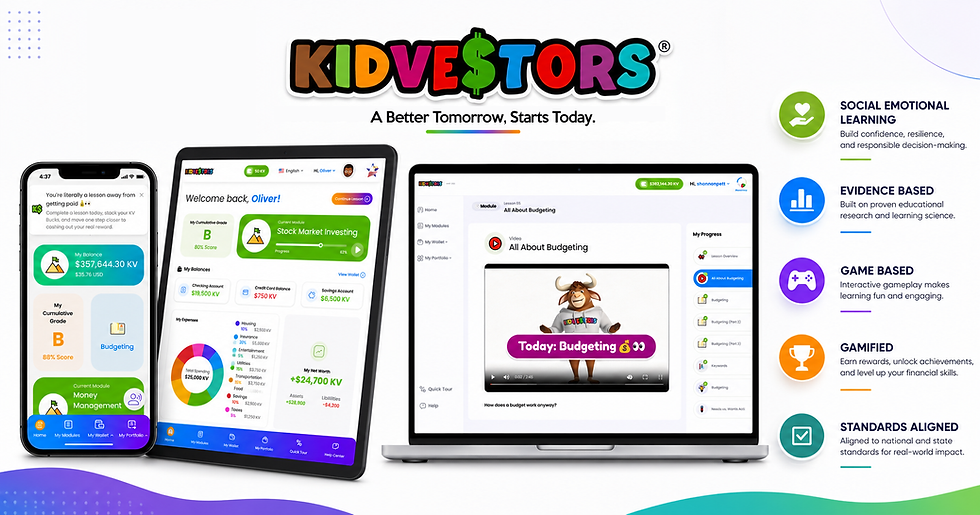
Best Financial Literacy Courses for Kids and Teens
Schools and families today are looking for more than just another worksheet or boring budgeting lesson.
They want financial literacy courses that actually prepare kids and teens for the real world. That means teaching students not only how to save money, but also how to think critically, build confidence, understand investing, explore entrepreneurship, and develop long-term wealth-building habits early.
The challenge? Not all financial literacy courses are built the same.
Some focus heavily on videos and quizzes. Others only cover basic money concepts. And while many programs do a great job introducing budgeting and saving, fewer platforms go deeper into investing, economics, entrepreneurship, and learning through real-world experiences.
That’s where modern, interactive platforms are beginning to stand out.
In this guide, we’ll compare some of the best financial literacy courses and online financial literacy course options for kids and teens, including:
Khan Academy
EVERFI
Banzai
MoneyTime
KidVestors
We’ll compare features like:
Gamification
Investing education
Entrepreneurship
Social and emotional learning (SEL)
Tangible rewards
Global access
Interactive learning experiences
And by the end, you’ll have a better understanding of which financial literacy course may be the best fit for your student.
1. KidVestors (Best Overall Financial Literacy Course for Kids and Teens)
KidVestors approaches financial education differently than many traditional financial literacy courses. Instead of relying mostly on videos and passive lessons, KidVestors focuses heavily on learning by doing.
Elementary, middle and high-school students actively participate through:
Quizzes
Challenges
Financial decision-making experiences
The platform teaches:
Financial literacy
Investing (stocks and real estate)
Real-world money skills
This broader focus makes KidVestors especially appealing for both schools and families who want students to go beyond basic money concepts and begin understanding how wealth is actually built.
Students learn about:
Stocks
Ownership
Business creation
Economic systems
Risk and reward
Long-term investing habits
Unlike many traditional financial literacy course platforms that primarily focus on spending and budgeting, KidVestors introduces students to wealth-building concepts earlier through practical, interactive experiences.
The KidVestors platform also integrates:
Multilingual accessibility
Global access across 100+ countries
One of the biggest differentiators is engagement. Rather than simply watching videos about finance, students actively practice concepts through simulations, challenges, games, and reward systems designed to keep them motivated and involved while earning cash and stock rewards along the way.
For many kids and teens, especially those who struggle with traditional learning environments, that hands-on approach can make a major difference.
Best for:
Schools and districts wanting researched backed, standards align education
Students interested in investing and entrepreneurship
Interactive learners
Wealth-building education
Gamified financial learning
Long-term financial confidence building
Khan Academy
Khan Academy is a financial educational platform online.
Its financial literacy course includes lessons on:
Budgeting
Saving
Credit
Interest
Taxes
Basic investing concepts
The biggest advantage is accessibility. Families can access lessons for free, making it a great entry point into financial education.
However, the learning experience is entirely video-based and lesson-focused. Students largely consume information through instructional content rather than interactive “learn by doing” experiences.
For self-motivated learners, this can possibly work well. But students who engage better through games, simulations, rewards, and hands-on learning may eventually lose interest.
Best for:
Free financial education
Supplemental learning
Independent learners
3. EVERFI Financial Literacy Program
EVERFI is widely used in classrooms and school districts.
The platform focuses heavily on:
Banking
Credit
Budgeting
Financial responsibility
Consumer decision-making
EVERFI offers interactive lessons and strong standards alignment, which makes it attractive for schools.
However, its experience still leans heavily toward traditional educational modules rather than immersive game-based learning. While students interact with lessons, the platform is less focused on investing, entrepreneurship, or wealth-building through ownership.
Best for:
Schools and districts
Teacher-led environments
Foundational personal finance education
4. Banzai
Banzai is known for scenario-based budgeting simulations.
Students work through realistic financial situations involving:
Bills
Spending
Saving
Emergency expenses
Budget decisions
Banzai does a strong job helping students practice financial tradeoffs in realistic situations.
However, the platform is primarily centered around budgeting and personal finance management. It places less emphasis on investing, entrepreneurship, economics, and wealth-building education.
Best for:
Budget simulations
Real-world spending practice
Classroom financial decision-making
5. MoneyTime
MoneyTime is designed primarily for younger learners (elementary and middle school).
The platform uses animations and interactive lessons to teach:
Saving
Spending
Earning
Basic budgeting
MoneyTime is approachable and beginner-friendly, especially for elementary students just beginning financial education.
However, older students looking to dive deeper into investing, economics, entrepreneurship, or advanced financial topics may eventually outgrow the platform.
Best for:
Elementary students
Introductory financial education
Younger learners

Best Financial Literacy Course Comparison Table
Feature | KidVestors | Khan Academy | EVERFI | Banzai | MoneyTime |
Age Range | Ages 8–18 (3rd-12th) | Teens+ | K-12 | Middle & High School | Elementary & Middle School |
National Standards Aligned | Yes | Yes | Yes | Yes | Yes |
Evidence-Based | Yes | No | Yes | No | No |
Gamification | High | No | Moderate | Moderate | Moderate |
Learn By Doing | High | No | Moderate | Yes | Moderate |
Investing & Wealth Building Focus | Strong investing & wealth-building focus | Basic investing only | Limited | Minimal | Basic concepts |
Economics Education | Yes | Minimal | Minimal | No | No |
Entrepreneurship Education | Yes | No | No | No | Minimal |
Financial Literacy Topics | Financial literacy, investing, economics, entrepreneurship | Budgeting, saving, taxes, credit | Banking, budgeting, credit | Budgeting, spending, bills | Saving, spending, budgeting |
Cash & Stock Rewards | Yes | No | No | No | No |
Social & Emotional Learning (SEL) | Yes | No | No | No | No |
Game-Based Learning | Strong game-based learning | Minimal | Moderate | Scenario-based | Moderate |
Interactive Simulations | Yes | Limited | Moderate | Yes | Limited |
Multilingual Support | Yes | Limited | Limited | Limited | Yes |
Platform Type | Web & App | Web only | Web only | Web only | Web only |
Region Served | 121 Countries Globally | Global | Primarily U.S. | Primarily U.S. | International |
Focus Beyond Basic Finance | Strong focus on investing, economics, entrepreneurship, and wealth-building | Limited | Moderate | Limited | Limited |
Learning Style | Learn-by-doing through games, simulations, activities, and rewards | Mostly videos and lessons | Interactive modules | Scenario-based practice | Animated lessons |
Pricing | Free trial + paid plans | Free | School-sponsored | Free/Paid school plans | Subscription |
What Makes the Best Financial Literacy Courses Effective?
The best financial literacy courses do more than simply explain money concepts.
They help students:
Practice decision-making
Stay engaged consistently
Build confidence
Apply what they learn
Develop long-term habits
That’s why engagement matters so much.
A student may technically “complete” a video lesson without retaining much information. But when students actively participate through simulations, games, investing activities, entrepreneurship exercises, and rewards, learning often becomes more memorable and practical.
That’s also why the strongest online financial literacy course platforms increasingly focus on:
Interactive learning
Behavioral reinforcement
Gamification
Real-world application
Confidence-building
Learn-by-doing experiences
Why KidVestors Stands Out Among Financial Literacy Courses
Every platform in this list offers value depending on a student’s goals.
But KidVestors stands out because it expands financial education beyond basic personal finance.
The platform combines:
Financial literacy
Investing
Economics
Entrepreneurship
Game-based learning
social and emotional learning (SEL)
Rewards
Interactive simulations
Most importantly, students are actively involved in the learning process.
Instead of simply watching videos about money, students learn through action:
Playing games
Completing challenges
Participating in simulations
Earning rewards
Exploring investing concepts firsthand
That “learn by doing” model helps financial education feel more practical, engaging, and relevant for today’s generation.
And for schools and families who want students to understand not only how to save money but also how to build wealth over time, KidVestors offers a broader experience than many traditional financial literacy courses currently available.
How to Enroll in KidVestors Financial Literacy Course
Ready to take the leap? Enrolling in KidVestors is super easy! Here’s how:
Try it out for FREE or choose your plan.
Click on the “Enroll Now” button to start creating an account for your kids. It’s quick, easy, and gets you started right away.
Start Learning Finance: Once enrolled, your kids can dive right into the fun world of financial literacy. They’ll play games, complete challenges, and even earn cash rewards for hitting their learning milestones.
Bonus! Get Paid!: Did you know that you can earn income by just referring KidVestors to a friend? Yep! Earn up to 30% for every referral through our Friend Frenzy affiliate program.
One of The Best Gifts You Can Give
Financial education is evolving.
Families are no longer looking only for budgeting worksheets and passive lessons. They want financial literacy courses that prepare kids and teens for the real world through engagement, interaction, and practical learning experiences.
Platforms like Khan Academy, EVERFI, Banzai, and MoneyTime each provide valuable educational tools depending on a student’s age and needs.
But for schools and families seeking a more modern approach focused on investing, economics, entrepreneurship, wealth-building, and learning through real-world experiences, KidVestors continues positioning itself as one of the most comprehensive online financial literacy course options available for kids and teens today.
Teach your kids financial literacy with our engaging platform.
BEST ONLINE FINANCIAL LITERACY COURSE FOR KIDS AND TEENS


Comments