


HOW SOCIAL AND EMOTIONAL LEARNING AND FINANCIAL LITERACY GO HAND IN HAND

Updated: Aug 16

What you'll learn:
When we think about financial literacy, most people picture numbers, budgets, and spreadsheets.
But here’s the truth: money decisions are rarely just logical.
They’re also emotional.
From impulse spending to saving for the future, our financial behaviors are shaped by how we think, feel, and respond in different situations. That’s where social and emotional learning (SEL) comes in.
If we want kids and teens to truly understand money, we have to go beyond teaching concepts and start focusing on behavior.
What Is Social and Emotional Learning (SEL)?
Social and emotional learning (SEL) is the process of developing the skills needed to understand and manage emotions, build relationships, and make responsible decisions.
In simple terms, it’s how we:
Understand ourselves
Manage our behavior
Interact with others
Make choices that impact our future
And here’s the key: every single one of those skills shows up in how we handle money.
Think about it:
Ever impulse bought something you didn’t need?
Avoided checking your bank account because it stressed you out?
Felt pressure to spend because your friends were?
That’s not solely a knowledge problem, but a behavior and emotion problem.
What Is the CASEL 5 Framework Competencies(And Why Is It the Gold Standard)?
When it comes to social and emotional learning, the CASEL 5 framework is widely considered the gold standard.
Developed by the Collaborative for Academic, Social, and Emotional Learning (CASEL), it outlines five core competencies:
1. Self-Awareness
Understanding your emotions, thoughts, and how they influence behavior.
2. Self-Management
Managing emotions, controlling impulses, and staying disciplined.
3. Social Awareness
Understanding others’ perspectives and recognizing social and cultural influences.
4. Relationship Skills
Building and maintaining healthy relationships through communication and collaboration.
5. Responsible Decision-Making
Making ethical, thoughtful, and informed choices.
The reason the CASEL 5 framework stands out is because it’s research-backed, widely adopted in education systems, and proven to drive better long-term outcomes.

How Social and Emotional Learning and Financial Literacy Work Together
Here’s where things get interesting. Financial literacy teaches what to do with money. Social and emotional learning teaches how and why you actually do it.
Let’s use a few real-world examples:
Self-Awareness → Recognizing Money Habits
A student realizes they tend to spend money when they’re bored or stressed.That awareness is the first step to change.
Self-Management → Controlling Impulse Spending
Instead of buying something immediately, they pause, wait 24 hours, and rethink the purchase.That’s discipline in action.
Social Awareness → Understanding Financial Perspectives
A teen recognizes that not everyone has the same financial situation.This helps them make more thoughtful, respectful decisions around money.
Relationship Skills → Talking About Money
Money conversations can be uncomfortable.But learning how to communicate about saving, spending, and goals builds confidence and clarity.
Responsible Decision-Making → Long-Term Thinking
Choosing to save or invest instead of spending everything now.That’s how wealth is built.
Why Most Financial Education Misses the Mark
Most financial education focuses heavily on information and barely touches behavior.
They teach:
Budgeting
Saving
Investing
But they don’t teach:
Why people overspend
How to manage financial stress
How emotions influence money decisions
And that gap? It’s the reason knowledge doesn’t always translate into action.

How KidVestors Combines Social and Emotional Learning and Financial Literacy
This is exactly why we built KidVestors the way we did.
We didn’t want to create another platform that just teaches financial concepts. We wanted to build something that actually changes behavior.
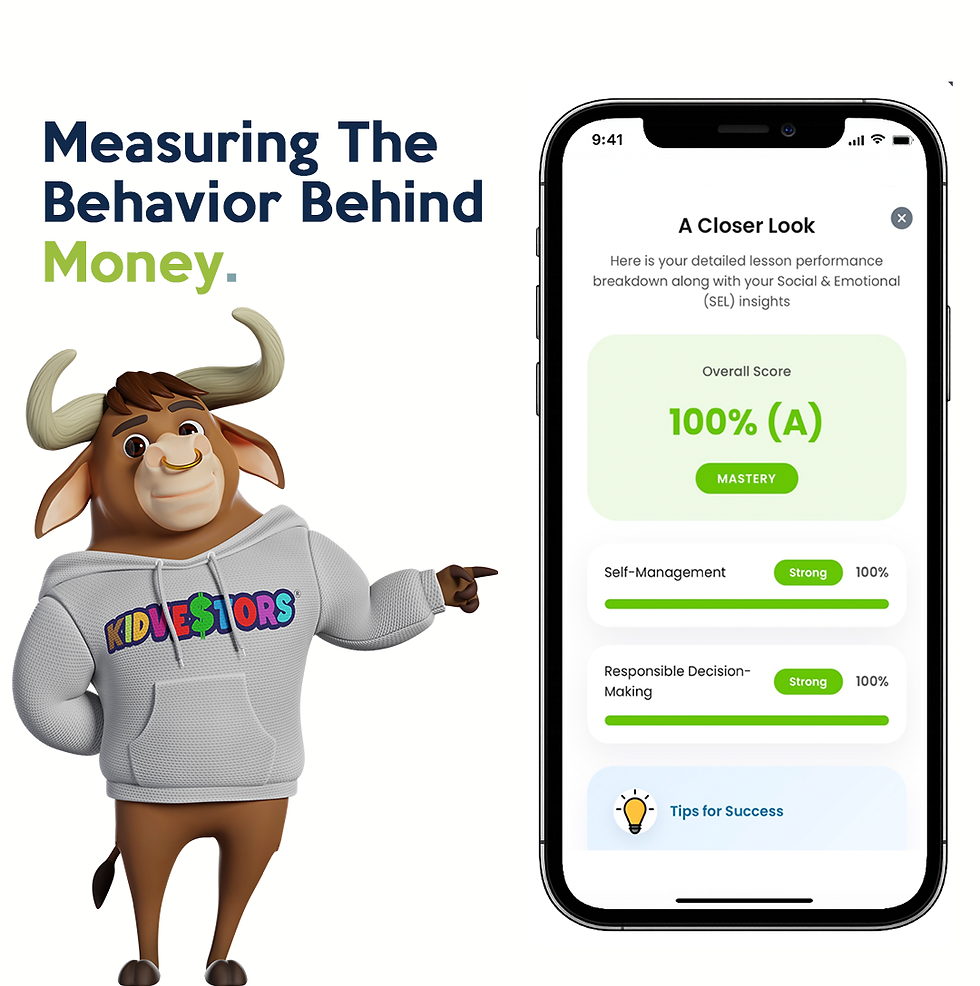
KidVestors is the first platform to intentionally combine social and emotional learning with financial literacy in a way that’s measurable, engaging, and real.
Here’s how we do it:
1. SEL-Driven Learning Design
Every lesson is built with social and emotional learning principles in mind, not just financial concepts.
2. CASEL 5 Integration
We track and reinforce the CASEL 5 competencies as students move through lessons, helping them build both financial and emotional skills.
3. Real-World Application
Students don’t just learn; they practice:
Making decisions
Managing trade-offs
Experiencing consequences in a safe environment
4. Behavioral Reinforcement
Through our “Earn While You Learn” model, students are rewarded for progress, reinforcing positive financial behaviors.
5. Data-Driven Insights
We don’t just assume learning is happening,we measure it. From confidence levels to decision-making patterns, we track real outcomes.
Because at the end of the day, financial literacy is about making better decisions consistently.
The Bigger Picture: Why This Matters
When we combine social and emotional learning with financial literacy, something special happens.
Students:
Build confidence with money
Develop healthier financial habits
Make smarter long-term decisions
Understand not just money, but themselves
And that’s how we start closing real financial gaps.
If we want the next generation to be financially capable, we have to rethink how we teach money. It’s not enough to focus on numbers alone.
We need to focus on behavior, mindset, and decision-making.
That’s where social and emotional learning changes the game.
Because when students understand their emotions, manage their behaviors, and think critically about their choices, they not only learn about money but also know how to build a healthy relationship with it.
Ready to see what KidVestors can do?
FAQs
1. What is social and emotional learning (SEL)?
Social and emotional learning (SEL) is the process of developing skills like self-awareness, self-management, and responsible decision-making to navigate life effectively.
2. Why is social and emotional learning important for financial literacy?
Because money decisions are driven by behavior and emotion. SEL helps students manage impulses, think long-term, and make better financial choices.
3. What is the CASEL 5 framework?
The CASEL 5 framework outlines five core SEL competencies: self-awareness, self-management, social awareness, relationship skills, and responsible decision-making.
4. How does SEL impact money habits?
SEL helps individuals recognize spending triggers, control impulses, communicate about money, and make informed decisions.
5. How does KidVestors use social and emotional learning (SEL) ?
KidVestors integrates SEL into financial education by aligning lessons with the CASEL 5 framework and reinforcing behaviors through real-world practice and rewards.
6. Can kids really learn financial literacy through SEL?
Yes. When combined, SEL and financial literacy create deeper understanding and long-term behavior change, not just surface-level knowledge.
FINANCIAL LITERACY, INVESTING, ENTREPRENEURSHIP AND ECONOMICS FOR KIDS AND TEENS


Comments